Beginner
General Theory of Functions
What a function is, how functions compose, and the properties that govern real-valued functions — the language every later course speaks.
Start Learning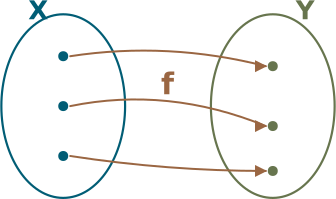
Learning Objectives
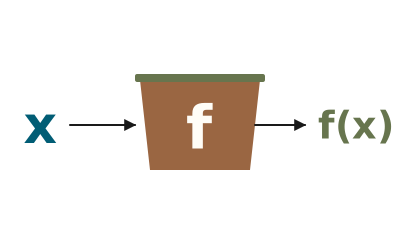
- Define a function as a rule that assigns to each element of the domain exactly one element of the codomain.
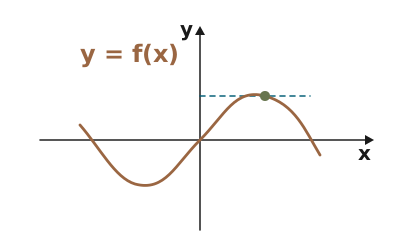
- Read and sketch graphs of functions; distinguish a graph from an arbitrary curve.
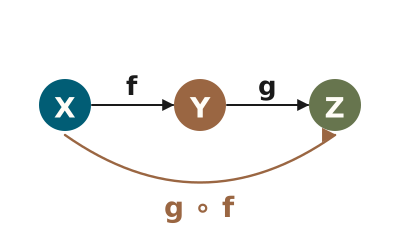
- Compose functions and compute the identity function.
- Determine whether a function is injective, surjective, or bijective.
- Construct inverse functions for bijections.
- Classify functions by monotonicity, parity, and boundedness.
About the course
This course develops the general theory of functions from the ground up: the definition, the graph, composition, bijectivity, inverse functions, monotonicity, parity, and boundedness. The linear and quadratic families, studied in subsequent courses, are the first concrete applications of this framework.