Beginner
The Linear Function
The first concrete family of functions: \(f(x) = ax + b\). Its graph, sign, and the first-degree equations, inequalities, and systems it gives rise to.
Start Learning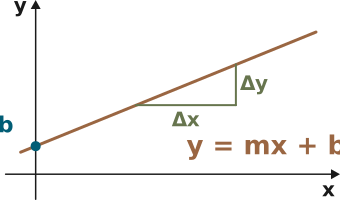
Learning Objectives
- Define the linear function \(f(x) = ax + b\) and distinguish the affine case from direct proportionality \((b = 0)\).
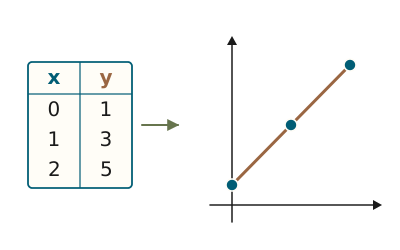
- Sketch its graph as a line and interpret the slope \(a\) and intercept \(b\).
- Determine the monotonicity and the sign of a linear function.
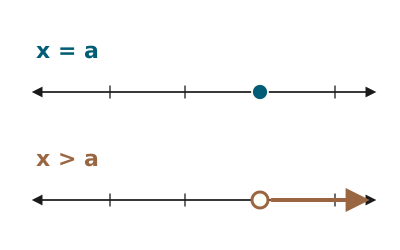
- Solve first-degree equations and inequalities, including the parametric discussion.
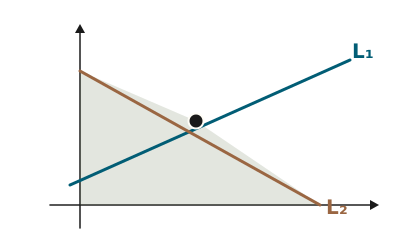
- Solve systems of two linear equations by substitution and elimination, and interpret them as intersecting, parallel, or coincident lines.
- Solve systems of linear inequalities and describe the feasible region in the plane.
About the course
Building directly on the general theory of functions, this course studies the linear (first-degree) function \(f(x) = ax + b\): its definition, its graph as a line, the geometric meaning of slope and intercept, its monotonicity and sign. From the sign of the linear function we develop first-degree equations and inequalities, and finally systems of linear equations and inequalities in two unknowns, read geometrically as configurations of lines in the plane.