
Sign, Inequalities, and Intersections
The sign of the quadratic function from the position of the parabola relative to \(Ox\), quadratic inequalities, and intersections of lines and parabolas.
Start Learning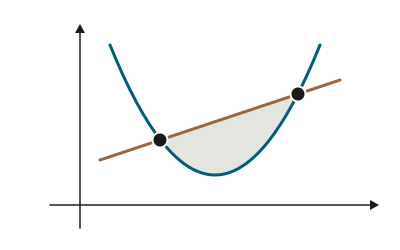
Learning Objectives
- Classify the position of the parabola relative to \(Ox\) by cases on \(\Delta\) and the sign of \(a\).
- Build the sign table of a quadratic function.
- Solve inequalities of the form \(ax^2 + bx + c \leq 0\) (and \(\geq, <, >\)), \(a \neq 0\).
- Decide whether a line is secant, tangent, or exterior to a parabola by reducing the system to a quadratic equation.
- Find the intersection points of two parabolas by solving the corresponding system.
About This Course Unit
The position of the parabola relative to the \(Ox\) axis, decided by the discriminant and the sign of \(a\), gives the sign table of the quadratic function and with it the solution of quadratic inequalities. The same discriminant test decides the relative position of a line and a parabola, and of two parabolas.