Beginner
The Quadratic Function
The quadratic equation \(ax^2 + bx + c = 0\) and the quadratic function \(f(x) = ax^2 + bx + c\): roots, Vieta's relations, the parabola, its sign, and quadratic inequalities.
Start Learning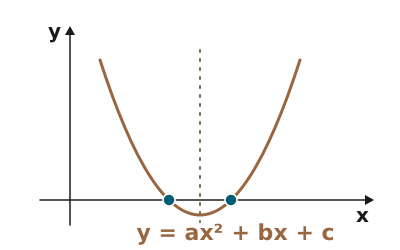
Learning Objectives
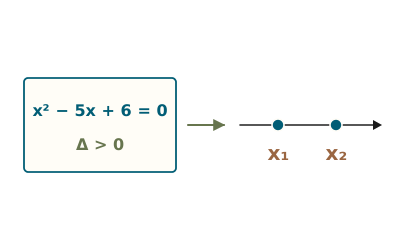
- Solve the quadratic equation \(ax^2 + bx + c = 0\) by completing the square and with the quadratic formula, and count its real roots from the sign of the discriminant.
- Use Vieta's relations to form equations from known roots, study the sign of the roots without solving, and solve symmetric systems.
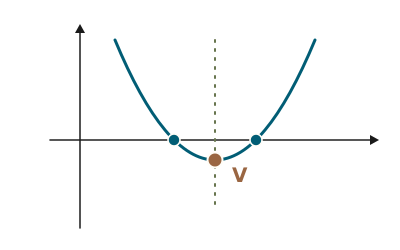
- Bring a quadratic function to canonical form and read off the vertex, the maximum or minimum, and the axis of symmetry.
- Sketch the parabola, including its intersections with the coordinate axes, and determine the monotonicity and the range of the function.
- Build the sign table of a quadratic function and solve quadratic inequalities.
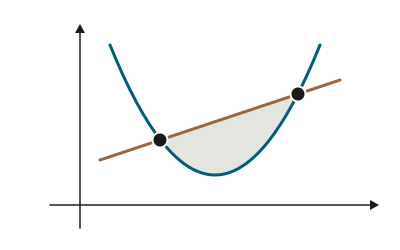
- Decide the relative position of a line and a parabola, or of two parabolas, by reducing their intersection to a quadratic equation.
About the course
This course studies second-degree expressions from two sides. First the equation \(ax^2 + bx + c = 0\): solving it by completing the square, the discriminant, Vieta's relations between roots and coefficients, and symmetric systems. Then the function \(f(x) = ax^2 + bx + c\): its canonical form, its graph — the parabola — with vertex, axis of symmetry, monotonicity, and range. Finally the two sides meet: the sign of the quadratic function, quadratic inequalities, and the intersections of lines and parabolas, all read from the discriminant.