
The Quadratic Function and Its Graph
The canonical form \(f(x) = a(x - x_V)^2 + y_V\), the parabola with its vertex and axis of symmetry, monotonicity, and the range of the function.
Start Learning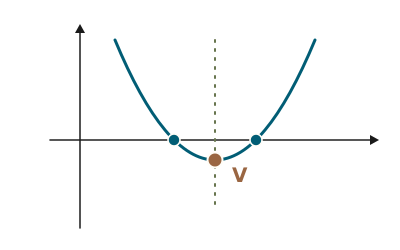
Learning Objectives
- Bring \(f(x) = ax^2 + bx + c\) to the canonical form \(f(x) = a\left(x + \tfrac{b}{2a}\right)^2 - \tfrac{\Delta}{4a}\).
- Read the vertex, the maximum or minimum value, and the axis of symmetry from the canonical form.
- Find the intersections of the graph with the coordinate axes and sketch the parabola.
- Describe the geometric aspect of the curve: concavity from the sign of \(a\), symmetry about the vertical axis through the vertex.
- Determine the monotonicity intervals and the range \(\operatorname{Im} f\) of a quadratic function.
About This Course Unit
We define the quadratic function and bring it to canonical form, which exposes the vertex, the maximum or minimum, and the axis of symmetry. Its graph is the parabola: we find its intersections with the coordinate axes using the equation from Unit 1, then read off the monotonicity and the range of the function.